
Claims
FNOL Flow (First Notice of Loss)
Built a customer-facing claims flow that improved how cases are submitted and routed, reducing payout timelines by ~50%.
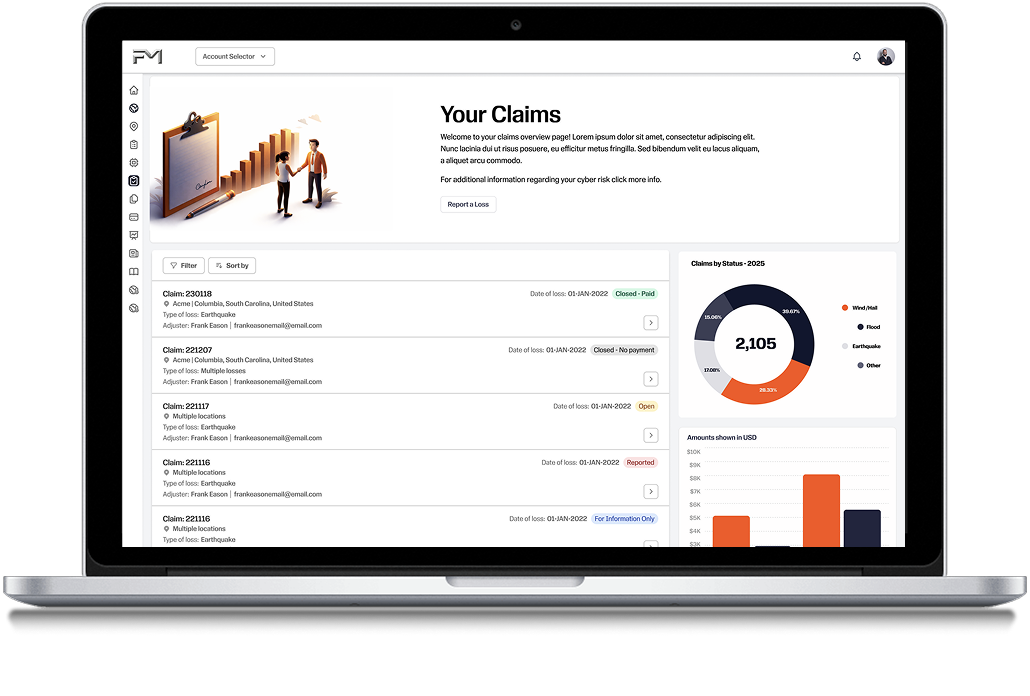
Problem
Claims were difficult to process efficiently, not because of missing tools, but because of how work moved through the organization.
Much of the claims intake and review process was handled manually. Information moved through calls, emails, and multiple handoffs, creating bottlenecks and delays — even for straightforward claims.
In some cases, lower-risk claims under established thresholds could be paid out quickly, but were still slowed by the same review paths as more complex cases. This resulted in unnecessary hold-ups, inconsistent timelines, and frustration for both claim handlers and stakeholders.
Previous Experience
Claims intake relied on manual inputs, disconnected patterns, and low-structure interfaces, increasing cognitive load and slowing processing.
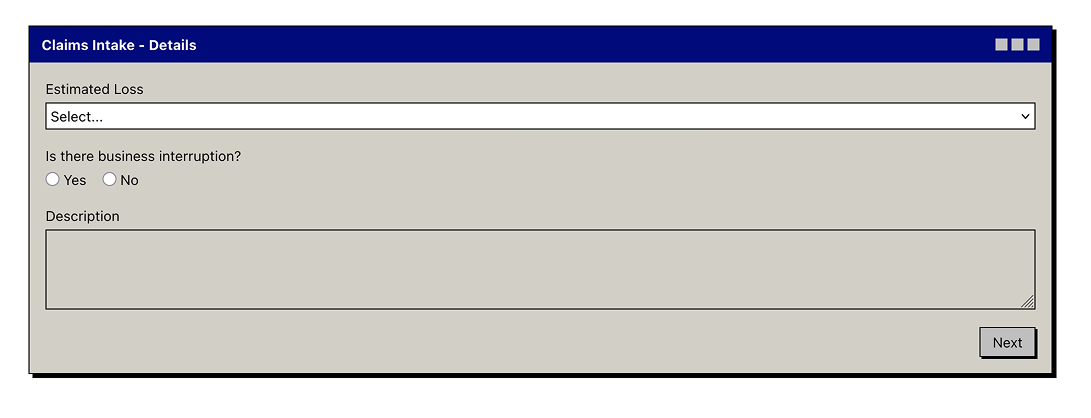
The intake process relied on basic form inputs with little structure or guidance, requiring users to interpret what information was needed.
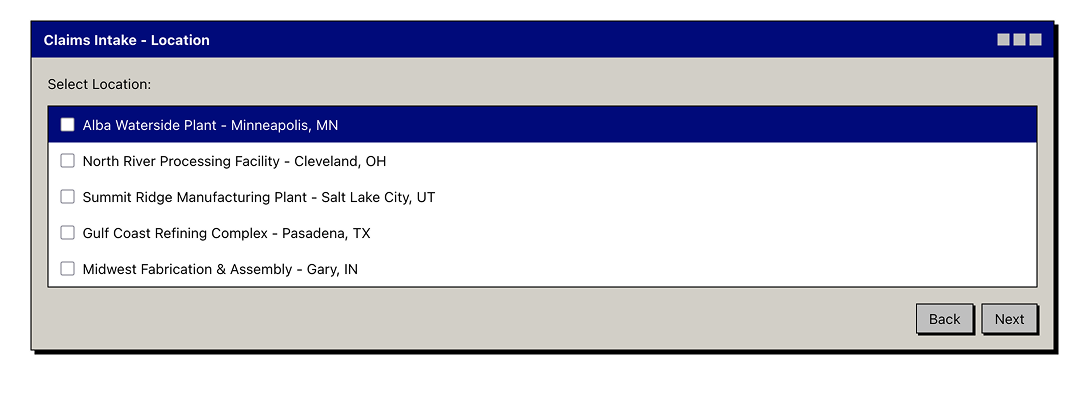
Location selection was list-based and checkbox-driven, with minimal hierarchy or feedback, making it difficult to scan and select accurately.
Business Objectives
| Focus | Business Need | Design Direction |
|---|---|---|
| Workflow Friction | Reduce reliance on calls, emails, and handoffs that slowed claims intake and review | Structure how information moves through the process to reduce manual coordination |
| Claim Routing | Prevent straightforward claims from being delayed by the same review path as complex cases | Introduce paths based on claim complexity and payout thresholds |
| Processing Speed | Reduce bottlenecks and delays across intake and review | Enable faster progression for lower-risk claims |
| Consistency | Reduce variation in timelines and how claims are handled | Establish clearer, more consistent workflow patterns |
Research Insights
Research focused on understanding how claims actually moved through the organization rather than how they were documented.
- Low-risk claims were often over-processed despite clear payout thresholds.
- Decision authority was unclear, leading to unnecessary escalations.
- Manual communication channels created visibility gaps in claim status.
- Similar claims were handled inconsistently, introducing delays and unpredictability.
These issues were not the result of individual mistakes, but of a system that treated all claims the same regardless of risk or complexity.
Design Challenge
The challenge was not to digitize the process, but to align it with how claims should be handled based on risk and complexity.
- Support faster paths for low-risk claims without compromising compliance
- Clarify ownership and decision points across roles
- Reduce unnecessary handoffs and follow-ups
- Work within existing policy, system, and regulatory constraints
My Role
I led the product design effort end-to-end, including research synthesis, workflow mapping across roles, information architecture, interaction design, and UI design.
I partnered closely with product, engineering, and subject-matter experts to validate assumptions and ensure design decisions aligned with operational realities.
Process
I began by mapping the current-state claims workflow across roles, decision points, and communication channels. This surfaced where claims were treated uniformly despite having very different risk profiles.
I then designed a future-state flow that introduced clear decision points early in the process. Based on claim characteristics and thresholds, the workflow could follow different paths while remaining part of a single, cohesive system.
The redesigned flow clarified where decisions should be made, who owned each step, and which claims required deeper review versus minimal friction.

Risk-based workflow showing how early decisions route claims through faster or more detailed paths based on complexity and thresholds.
Key Screens
The interface design focused on the primary claim intake task. The goal was not to automate judgment, but to support it by structuring information in a way that aligned with downstream decisions.
The core task screen demonstrates how relevant information is grouped by decision context, requirements are made explicit at the moment they matter, and different claim paths are supported without unnecessary steps.

The Details step captures classification and loss information early, setting up downstream steps and reducing rework later in the process.
Nested Attachment Flow
What initially appeared to be a simple attachment step evolved into a nested workflow with its own requirements, validations, and downstream impact.
File Upload
As soon as supporting files were introduced, the claim path diverged — triggering additional data capture, conditional logic, and review states that could not be handled inline without increasing cognitive load.
Treating this as a contained sub-flow allowed standard claims to move quickly while ensuring higher-risk scenarios captured the right information early, reducing follow-up and rework later in the process.
Adding/Editing a Location
This same pattern emerged again when adding new locations mid-claim. What appeared to be a simple action introduced conditional requirements, validation states, and downstream impacts that could not be handled inline without breaking the primary flow.
Solution
The final solution aligned the claims experience with how work actually needed to happen.
By introducing clear decision points and conditional paths, the workflow supported faster handling of low-risk claims while preserving appropriate review for more complex cases. Manual communication was reduced by making ownership, requirements, and next steps explicit within the system.
Outcome
A new claims lifecycle was designed to streamline compliance-heavy intake and validation workflows, increasing operational productivity and reducing payout timelines by approximately 50%.
By separating low-risk claims from more complex cases, the system removed unnecessary bottlenecks while maintaining the oversight required for higher-risk scenarios.
With additional time, I would introduce instrumentation to measure throughput, decision time, and handoff frequency, enabling continued optimization based on real-world usage.