
XCloud
Design leadership and hands-on product design for an enterprise recruitment platform integrating ATS, CRM, and analytics.
Context
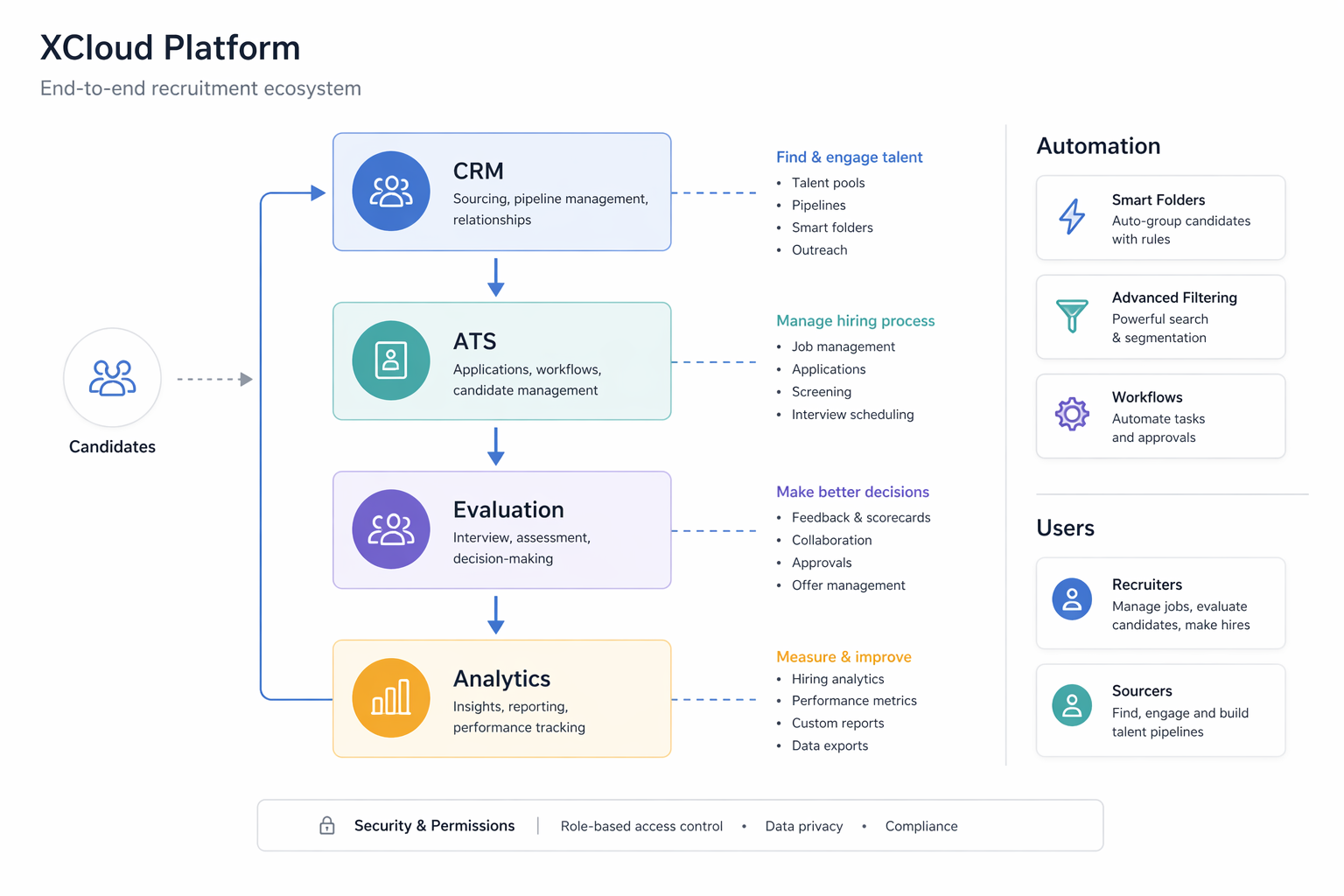
XCloud was an enterprise recruitment platform built from the ground up following the evolution of an earlier product, Findly. The goal was to create a cohesive ecosystem supporting recruitment marketing, applicant tracking, CRM workflows, and analytics within a single, scalable platform.
The product was developed in a race-to-market environment, with limited research access, a small team, and aggressive delivery timelines. Design decisions needed to balance long-term platform foundations with immediate business and delivery constraints.
Over five years, the platform expanded in scope, complexity, and customer impact, forming the foundation for a broader suite of enterprise recruitment tools.
My Role & Scope
I served as a Senior UX Designer and Design Manager, leading design while remaining hands-on across critical areas of the product.
- Led and mentored a small design team
- Defined information architecture across ATS, CRM, and analytics workflows
- Designed core interaction patterns and UI foundations
- Partnered closely with product leadership and engineering
- Made early design decisions that needed to scale over multiple years
- Contributed directly to UX, interaction design, and visual direction
This was not a single feature or release — it was sustained product design leadership across an evolving enterprise platform.
Product & UX Focus
Given the scope of the platform, design efforts focused on clarity, speed, and decision-making for enterprise recruiters and sourcers operating in high-volume environments.
- End-to-end hiring workflows across ATS and CRM
- Information prioritization to help users assess candidates quickly
- Scalable interaction patterns that could support future features
- Automation concepts to reduce manual review and repetitive work
Rather than designing isolated screens, the work centered on creating reusable patterns and systems that could support multiple products and user roles over time.
Key Design Contributions
Information Hierarchy & Candidate Review
Early testing revealed that recruiters struggled to quickly assess candidates due to missing or buried information. Design efforts focused on prioritizing the most critical data at decision points without overwhelming the interface.
This led to interaction patterns that surfaced key information contextually while preserving screen real estate.
Quick View & Decision Support
Candidate review needs varied significantly by role and organization. To address this, we introduced a “quick view” interaction that allowed users to access relevant candidate information without leaving their workflow, supporting faster decision-making while maintaining flexibility.
ATS vs CRM Workflow Separation
Research and usage patterns showed distinct behavioral differences between recruiters and sourcers. Recruiters primarily worked within ATS flows, while sourcers spent most of their time building and managing pipelines within the CRM.
Design solutions reflected these differences, ensuring each workflow supported the mental models and priorities of its primary users while remaining connected within a single platform.
Automation & Smart Folders
To reduce manual effort, we introduced automation concepts such as Smart Folders, which automatically grouped candidates based on defined criteria. This helped teams manage volume more efficiently while maintaining control over how candidates were organized and reviewed.

Reflection
XCloud was a defining experience in designing and leading complex enterprise software over time. Working under real-world constraints — limited research access, aggressive timelines, and evolving product strategy — required balancing immediate delivery with long-term platform thinking.
This project strengthened my ability to lead design within ambiguity, make scalable decisions early, and contribute meaningfully across UX, interaction design, and team leadership. It also reinforced the importance of designing systems that can grow with both the product and the organization.